N+2: Muñecos
Mostrando entradas con la etiqueta Muñecos. Mostrar todas las entradas

24 mayo 2012

La Ollera - Juan Manuel Costa (2009)


The Potter
Sin Diálogos / No Dialogue

En un mercado popular, una alfarera vende sin mucha suerte sus ollas de barro cocido, al contrario de la vendedora del frente, quien vende sus ollas como pan caliente. Atraída por la curiosidad la joven alfarera decide investigar cuál es ese secreto que hace que las ollas de esta misteriosa mujer sean tan apreciadas por todo el pueblo, cuál es esa magia que infunde tal espíritu a estas pequeñas ollas.


Un lindo cortometraje, elaborado en claymotion, que fusiona rasgos culturales amazónicos y andinos, dotado de un profundo sentido ritual; una linda metáfora del sentido mágico del creador en relación a su creación, vista desde la perspectiva de estos pueblos.


"Juan Manuel Costa nació en la ciudad de Salta. Desde hace mas de 6 años se dedica a la investigación y experimentación en la animación stopmotion.

Ha dirigido dos cortometrajes animados: “El Birque (génesis)” y “Elvira” con los que ha obtenido mas de una veintena de premios tanto nacionales como internacionales.
Actualmente acaba de finalizar de su último cortometraje titulado “La Ollera”. Recientemente ha conformado "El Birque Animaciones", un estudio de animación tradicional en donde realiza trabajos para terceros."


"The secret to end all secrets? There ain’t no such thing as a secret! Unfortunately, that’s a secret. (Don’t try to make any sense of this. It was supposed to be paradoxical, but I just failed at that…)
La Ollera is a magically wonderful stop animated short film written and directed by Juan Manuel Costa and produced at El birque."


LINKS

http://rapidshare.com/files/4060019813/2009Ollera.J.M.Costa.wwwnplus2.org.part1.rar
https://www.rapidshare.com/files/1711656010/2009Ollera.J.M.Costa.wwwnplus2.org.part2.rar
https://www.rapidshare.com/files/3589945834/2009Ollera.J.M.Costa.wwwnplus2.org.part3.rar

15 mayo 2012

Mest kinematograficheskogo operatora - Wladyslaw Starewicz (1912)


Месть кинематографического оператора / La venganza del camarógrafo / The cameraman's revenge
Silente / Silent

"El matrimonio de clase social media alta formado por el señor Escarabajo y la señora Escarabajo ha sido devorado por el tedio, y el señor Escarabajo hace frecuentes viajes para echar canitas al aire. Una noche se presenta en un club nocturno, en el que hay una libélula actuando como cantante y bailarina. Un saltamontes está locamente enamorado de la libélula, pero el señor Escarabajo tiene más dinero, y la libélula se va a pasar la noche con él. Además, el señor Escarabajo tiene una reacción muy poco galante con el saltamontes, y lo humilla públicamente. Lo que él no sabe, es que el saltamontes es cámara de cine y que rumiando su rabia se dispone a tomar venganza: lleva su cámara, sigue a la pareja, y se pone a filmarlos cuando éstos han ido a un hotel para estar solos. Entre tanto, la señora Escarabajo está en casa viéndose con otro segundo saltamontes, un artista bohemio. El señor Escarabajo regresa a casa una vez se ha desahogado bien con la libélula, y allí coge in fraganti a su esposa con el saltamontes artista, que huye por la chimenea. Entonces el hipócrita coleóptero pega a su mujer, y le monta una bronca tremenda, haciéndose el ofendido. Al día siguiente, el matrimonio aparece en público como si no nada hubiese pasado, guardando las apariencias, para ir a una proyección de cine. Entonces ocurre lo más inesperado para ellos: la película que están viendo se corta, y en su lugar alguien, el saltamontes despechado, pone la película del señor Escarabajo con la libélula que grabó en plan paparazzi. La señora Escarabajo se entera de la verdad de esta manera, y también el resto de la sociedad moscovita..."
Hawkmenblues (Filmoteca HawkmenBlues)
 
 
"Las películas de Ladislaw Starewicz (1882-1965), referente ineludible de la técnica del stop-motion (animación fotograma a fotograma), destacan por la singularidad de la puesta en escena, normalmente realizada con sofisticados animales a caballo entre el museo de zoología y la fantasía surrealista. Entomólogo de formación y cineasta autodidacta, Starewicz filmó en Rusia y Francia más de un centenar de películas, desde principios de siglo hasta 1965. Tras iniciarse en el cine en los estudios Khanzhonkov y dirigir cine con actores, descubrió en la animación un medio ideal para desarrollar su desbordada imaginación, su habilidad técnica y su destreza como titiritero. Cien años más tarde, gracias a la actualidad de las historias y a la manera de contarlas, sus marionetas mantienen toda su vigencia.

Starewicz se inició en la técnica stop-motion con intenciones documentales, para reproducir el apareamiento de los escarabajos-ciervo, imposible de registrar en vivo con los medios de la época. Así, con Lucanus Cervus (1910), se convierte involuntariamente en un pionero de la animación de marionetas. Si bien Emile Cohl, Méliès o Segundo de Chomón habían utilizado la técnica del rodaje foto a foto con anterioridad, es Starewicz quien le saca el máximo partido con sus sorprendentes e imaginativas historias. A partir de Lucanus Cervus, hoy perdida, Starewicz se adentra de lleno en el mundo de las fábulas y otras ficciones interpretadas por alucinantes criaturas de su factura. Sus personajes, hechos algunos a partir de esqueletos de pájaros y animales antropomórficos cubiertos de pieles verdaderas, parecen sacados de un peculiar gabinete de maravillas. Su técnica y calidad artística han sido alabadas por directores como Terry Gilliam, Nick Park y John Lasseter, y han influido notablemente en el trabajo de realizadores como Tim Burton, los hermanos Quay, Joel Meter-Witkin y Kyle Cooper.

Aunque Starewicz gozó de reconocimiento en su época, -e incluso se le comparó con Walt Disney en los años treinta-, tras su muerte, sus películas fueron cayendo en el olvido. No sería hasta principios de los años noventa del siglo pasado, cuando festivales especializados como el de Annecy o el de Ottawa, e historiadores de la talla de Giannalberto Bendazzi o Jane Pilling, lo rescataran de nuevo. En el año 2002 se restauró finalmente el total de su obra francesa (dedicada a la animación). Las películas de su período ruso (es decir, previas a 1920, fecha en que se trasladó Francia) no han tenido la misma suerte. (...)"
 
 
"Amongst the early animation pioneers, the name of Wladyslaw Starewicz stands as one of the most revolutionary animators of all time, as his work in puppetry and stop motion animation has proved to be enormously influential. Born in the Russian Empire (in what is now Lithuania) Starewicz entered animation while working at the Museum of Natural History in Kovno, back in 1910. Trying to make short educational documentaries for the museum, Starewicz found himself unable to film a battle between two stag beetles, which as nocturnal creatures weren't too keen of the lighting needed for filmmaking. An inspired Wladyslaw Starewicz decided to recreate it through stop motion animation and the result was "Lucanus Cervus". To this first puppet animation with insects followed many more, which earned Starewicz international acclaim thanks to the great care he put to his animation. Amongst his oeuvre, his most famous films remain his shorts with insects, of which the best known is a funny masterpieces titled "Mest kinematograficheskogo operatora" or "The Cameraman's Revenge".

In its barely 12 minutes of runtime, "Mest kinematograficheskogo operatora" tells the tale of Mr. and Mrs. Beetle, a normal looking marriage between insects. However, behind the apparent happiness of the Beetles household, Mrs. Beetle is having an affair with another insect while Mr. Beetle is at work. As soon as Mr. Beetle leaves the house, she calls her lover, an artist, to spend the afternoon with her. Nevertheless, the cuckold husband Mr. Beetle isn't exactly an example of fidelity himself, as he leaves work early to visit his favorite club, "The Gay Dragonlfy", where his mistress (a Dragonfly) sings and dances. However, a Grasshopper is also in love with the beautiful Miss Dragonfly, which results in him getting beaten by Mr. Beetle. However, Mr. Beetle doesn't know that the Grasshopper is a filmmaker, and he films Mr. Beetle's extramarital affair in order to have his revenge. Going back home, Mr. Beetle finds his wife's lover and also beats him out. After his violent outburst, Mr. Beetle decides to forgive Mrs. Beetle and takes her to the movies, not knowing that the cameraman is ready to show his film.

 
Written and directed by Wladyslaw Starewicz, "Mest kinematograficheskogo operatora" is apparently a pretty simple story about an adulterous couple (in fact a common topic in short comedies of the era), however, there's more than just that in Starewicz' film, as the movie also presents the possibility of film as evidence of an act. Cinema as a weapon of sorts as in a way, Mr. Grasshopper's camera becomes the instrument of his revenge revenge on Mr. Beetle. In his writing, Starewicz also shows a taste for irony in his sharp criticism of the hypocrisy of the social values of his time. This is best represented in the moment when Mr. Beetle discovers his wife's infidelity, as the cuckold husband becomes furious and, after beating the lover, shows his "generosity" and forgives his wife, even when it's already clear that he is not really an innocent beetle. Certainly, her posterior violent outburst is not caused by her husband's infidelity, but by his blatant hypocrisy.

However, beyond the film's touch of comedy (which is great), what truly makes "Mest kinematograficheskogo operatora" a remarkable movie is without a doubt the innovative use of puppet insects to tell the story. In "Mest kinematograficheskogo operatora" can be fully appreciated the great amount of care that filmmaker Wladyslaw Starewicz put into his projects, not only in the extraordinarily detailed props and costumes built for the movie (to the point that the Beetles wear boots), but in the extremely fluid stop motion animation he achieves. It's almost as if the insects were really riding motorbikes or operating a camera. Also, using purely visual narrative, Starewicz manages to give personality to his insects, he fully humanizes them in remarkable ways. This isn't an easy feat, because since Starewicz' puppets are real insects, they obviously lack facial expressiveness, so what Starewicz does is to use their actions to tell who these people are, showing an enormous understanding of cinema as a storytelling medium.

As written above, the work of Wladyslaw Starewicz would give the Russian filmmaker international acclaim, and the chance to keep improving his technique. Eventually, Starewicz would experiment with many other styles, including directing live action films (like "Noch pered Rozhdestvom"). The October revolution would briefly pause his career, as he and his family fled to Paris. It would be in France where Starewicz would polish his style and move towards a more surreal vein. Of great influence for animators across the globe, Starewicz' "Mest kinematograficheskogo operatora" remains a testament of its maker's great imagination and his great domain, not only of stop motion animation, but of cinema's purest visual narrative."

LINKS

https://www.rapidshare.com/files/692174486/1912MiestKinooperatora.W.Starewicz.www.nplus2.org.part1.rar
https://www.rapidshare.com/files/1624324064/1912MiestKinooperatora.W.Starewicz.www.nplus2.org.part2.rar

11 mayo 2012

Kipling Jr. - Koji Yamamura (1995)


ップリングJr.
Japonés / Japanese | Subs: Castellano

Cortometraje elaborado con muñecos de plastilina y animado mediante stop-motion que narra las aventuras y maravillas que el pequeño Kip vivirá junto a una extraña banda de tres particulares músicos en la gran ciudad.


"Kipling es un perrito que vive con sus padres en una casita, a las afueras de la ciudad, al pie de las vías del tren. Le encanta lamúsica. Un día se va con sus padres a la ciudad, donde todo le maravilla. Al cabo de un tiempo vuelve a ir totalmente solo; Kipling se está haciendo mayor. (...)"


"Nacido en 1964, el maestro Yamamura, inicia su carrera creando pequeñas animaciones cuando aún estaba cursando la secundaria, en ese entonces con apenas 13 años. Desde el inicio su trabajo llamaba la atención; su particular visión que se separaba dramáticamente del concepto que reinaba en el Japón con respecto al anime y las artes visuales.

Sus trabajos combinan la escultura en barro con figuras tridimensionales, fotografía, crayola y multimedia, mezclando técnicas y tendencias como el puntillismo y minimalismo, llevándonos a través de un mundo único donde la experimentación da como resultado nuevas tendencias visualmente impactantes y ricas en contenido. El surrealismo que impera en su trabajo y su tremenda sujeción a la estética pura, se traduce en un placer para los sentidos, donde el anime sé reinventa, transformándose a sí mismo.


En el año de 1993 el maestro funda el Yamamura Animation Inc. siendo inmediatamente reconocido y solicitado para realizar trabajos, logrando inclusive ser invitado en un tiempo muy corto ( de hecho todo un tiempo record que hasta la fecha ningún estudio a logrado ), a formar parte de la Asociación de Animación Japonesa y el Japan Chapter of the International Animated Film Associated, donde frecuentemente es buscado por los estudios de animación para que supervise los departamentos creativos tanto en el Japón como fuera de él.

Al igual que Tabaimo el maestro utiliza como excusa la critica a la sociedad contemporánea, satirizándola brillantemente por medio del uso de iconos de la cultura japonesa, y la actitud despreocupada de la sociedad hacia la tradición. La película animada Mthead, siendo su más conocido, la logrado recibir el reconocimiento de la critica internacional, gracias al peculiar sentido del humor utilizado por Yamamura, algunas veces algo insólito para el público occidental."


"A fantastic animation adventure about Kipling Jr., his father, mother, and a musical band led by Rog. Advanced animation techniques, yet to be seen on the screen, help to create incredible movements by animated dolls.

Awarded Honorable Mention Short Animation Film by Festival's Adult July Chicago International Children's Film Festival
Has invited from 96 Seoul International Cartoon and Animation Festival, FANTOCHE International Animation Film Festival Baden , The Festival of Light Filmfest and ANIMAC Mostra International de Cinema D'Animacio LLEIDA
Won Certificate of ParticipationAwards from Ottawa international animation festival, INTERNATIONAL FESTIVAL OF VISUAL ARTS, HUNGARY and 22th Hong Kong International Film Festival (...)"


LINKS

https://www.rapidshare.com/files/4023536291/1995KiplingJr.K.Yamamura.www.nplus2.org.part1.rar
https://www.rapidshare.com/files/241095021/1995KiplingJr.K.Yamamura.www.nplus2.org.part2.rar

Subtítulos

https://www.rapidshare.com/files/3502738028/1995KiplingJr.K.Yamamura.www.nplus2.org.srt

09 mayo 2012

Belaya Arena - Irina Gurvich (1987)


Белая арена / Blanca arena / White arena
Sin Diálogos / No Dialogue

Cortometraje que nos lleva a la función de un circo, pero no a una función corriente: este es un circo hecho de papel; donde un romántico payaso es el anfitrión que presenta las hazañas de la domadora de caballos, el encanto de la amaestradora de aves, la sutileza de la equilibrista y la potencia muscular del hombre fuerte. Sin embargo, como en todo espectáculo, no todo es alegría, también la tristeza se apoderará de nuestro carismático anfitrión.


Film elaborado cuidadosamente con figuras tridimensionales hechas de papel, animadas mediante la técnica de Stop-motion.


En la web no hay mucha información disponible de la obra ni de la autora, pero por lo poco encontrado se puede decir que Irina Gurvich, la animadora de origen ucraniano, es un referente en la historia de la animación de dicho país.


LINKS

https://www.rapidshare.com/files/3344962045/1987BelayaArena.I.Gurvich.www.nplus2.org.part1.rar
https://www.rapidshare.com/files/1963122962/1987BelayaArena.I.Gurvich.www.nplus2.org.part2.rar

03 mayo 2012

Aria - Pjotr Sapegin (2001)


Sin Diálogos / No Dialogue

Adaptación basada en la ópera "Madama Butterfly", compuesta por Giacomo Puccini. Aria narra la historia de una joven que cede ante el amor de un marinero que arriba en la bahía donde ella vive. Después de un carnal y apasionado encuentro él debe partir de rumbo abandonando a la joven, quien, acompañada solamente de la criatura que lleva en el vientre y de un viejo gramófono que no deja de reproducir la triste melodía del aria Un bel dí vedremo (Un bello día veremos), no imagina los infortunios que le depara la amarga espera de ese ingrato amor.


"Pjotr Sapegin nació en Moscú, Rusia, en 1955. Sus padres eran pintores, pero corrían malos tiempos para el arte y apenas sobrevivían con su trabajo. Como muchos jóvenes de su época en la Unión Soviética, Pjotr se interesó por el deporte, ejercitándose en las modalidades de esquí de slalom y karate. Sin embargo, con el tiempo estudió pintura y luego asistió a una escuela de teatro. Trabajó 15 años como diseñador de escenarios para varios teatros de Moscú, antes de buscar otro camino y marcharse a vivir a Noruega.

Cuando llegó a Noruega en 1990, Pjotr comienza a trabajar en varias revistas de arte y teatro, cualquier trabajo que permitieran a su familia comer. En esta nueva aventura, Pjotr conoce a varios directores de cine de animación noruegos, y decide aprender las técnicas. Desde entonces no ha parado de trabajar en la animación, abarcando tanto cortometrajes como anuncios publicitarios, logrando reconocimiento a nivel internacional.

Este fantástico cortometraje " Aria ", es una muestra de su talento. Es una adaptación de la ópera Madame Butterfly del compositor italiano Giacomo Puccini ( 1858 - 1924 ). Realizado en 2001 con producción canadiense, se llevó premios al mejor cortometraje en los festivales de Noruega, Leizpig, Montreal y Arhus Film Festival.


Resumidamente, la ópera Madame Butterfly de Puccini, transcurre en Nagasaki, a finales del siglo XIX o principios del XX. Es la historia de una quinceañera japonesa llamada Cio-Cio-San (Señorita Mariposa) y el oficial de la marina estadounidense Pinkerton. La enamorada Butterfly rechaza casarse con Yamadori, un príncipe que la pretende, y se casa con el oficial extranjero, pero para Pinkerton sólo es una aventura fuera de su país. Durante el casamiento la familia de Butterfly la maldice por traicionar las costumbres niponas y reniegan de ella.
Pero pronto él tiene que regresar a su patria, ella le espera durante tres años a pesar de que todo el mundo le dice que no regresará. En ese tiempo ella cría a su hijo, el cual nació después de que el oficial se fuera. Tras tres años, Pinkerton finalmente regresa y con él su nueva y legítima esposa norteamericana Kate. Al enterarse de la existencia del hijo deciden recogerlo para criarlo en los Estados Unidos. La desolada Butterfly se lo entrega no sin antes despedirse, sin amor y sin hija se retira a sus habitaciones y comete Seppuku.

Pero Pjotr Sapegin no se limita a hacer un remake exacto de Madame Butterfly. Todo lo contrario, su adaptación es bastante libre, pues solamente utiliza a cuatro de los personajes de la obra original. Butterfly, Pinkerton, Kate y el niño, pero con ellos es más que suficiente para representar toda la esencia de la obra. Además del excelente final adaptado a las circunstancias, y una música de fondo bellisima.
Majestuoso."


"Siempre uno tiene el derecho de rehacerse cuando la vida es demasiado cruel, cuando no podemos cargar el peso total de nuestras malas decisiones, es el derecho inherente del hombre de volver a nacer, de renunciar al trance de haberlo perdido todo. Nadie está libre de ser devorado por la ternura o por el incomprensible poder del desprecio, y de eso trata este cuento corto de Pjotr Sapegin, de la metamorfosis a una nueva vida, como la mariposa, deshacer el cuerpo entero para volver a tener ganas de sonreír. En apariencia macabro y cruel, en realidad lo que ha querido el autor es hacer una secuencia de una vida en sus matices más intimos, como el el nacimiento, la espera, el olvido, la renuncia, el amor y la ternura que viene del egoísmo puro, eso a logrado Pjotr Sapegin con su "Aria""


"I never cried watching a movie. Never, with a single exception. This one. So, prepare the napkins, you may need some: this movie has probably the most painful final scene ever.

The story is a variation on Giacomo Puccini’s Madama Butterfly, set on a tropical island. A sailor lands, meets a girl, makes love with here and leaves the day after. After giving birth to his daughter, the girl will wait for the man to come back.

This stop animated movie has been directed and animated by Pjotr Sapegin and produced by Pravda and National Film Board of Canada.

Released in 2001, the film garnered 10 international awards, including the Wooden Wolf Grand Prize at the Black Nights Film Festival of Tallin.

Born in Russia in 1955, Pjotr Sapegin worked as a set designer in various theatres in Moscow for 15 years. He became involved in puppet animation after moving to Norway in 1990 where he now co-owns the Pravda production company in Oslo. (Source: National Film Board)

The aria that accompanies the images is Un bel dì vedremo as sung by Natalie Choquette. (...). While the main character is an original creation, to avoid legal issues the author used a look alike puppet that he made as the Barbie, and a Pakistani bootleg copy as Ken. (...)"


"This short with its roots in the M Butterfly saga has more ideas and images crammed into its 11 minutes than many full-length features. I found this to be a fascinating film. How inanimate and even somewhat crude dolls were made to show the emotions that the main characters here did should be a lesson to all filmmakers.

This is a masterful short.(...)"
Havan_IronOak (IMDb)


LINKS

https://www.rapidshare.com/files/474374785/2001Aria.P.Sapegin.www.nplus2.org.part1.rar
https://www.rapidshare.com/files/3303558914/2001Aria.P.Sapegin.www.nplus2.org.part2.rar

11 abril 2012

Monsieur Cok - Franck Dion (2009)


Señor Cok / Mister Cok
Sin Diálogos / No Dialogue

El Señor Cok, un anciano con forma de misil, es un megamagnate de la industria armamentística y fiel representante del mundano espíritu del capitalismo. Convencido de la eficiencia de la máquina sobre la mano de obra humana, el señor Cok decide reemplazar a sus obreros por humaniodes mecanizados; Sin embargo el espíritu obrero (representado por un enérgico trabajador parecido a Marx) aparentemente pasivo, tiende a la inconformidad, aunque tal desición quimérica lo conduzca a la autodestrucción. 


Una obra visualmente muy bien lograda, cuyo dicurso fusiona, mediante su estética retro-futurista, los elementos del comunismo marxista de principios del S. XX (opresión del proletariado, el naciente maquinismo o diferencias de clase) con las modernas relaciones de poder (asociaciones entre las grandes corporaciones de la industria armamentística con instituciones políticas o religiosas). 


Esta es la segundo obra de Dion, siendo L'inventaire fantôme la primera, ambas premiadas como se merecen. El film fue elaborado a partir de diferentes técnicas, como ser cut-out, fotografías de muñecos, gráficos en 2D,  y retoques por ordenador.


Mister Cok is the owner of a large bomb factory. Looking for efficiency and profit, he decides to replace his workers by sophisticated robots; however one of the workers does not accept being discarded so easily.
(IMDb)


"which Franck Dion created the drawings, the sets and sculptures that the movie needed. The movie was animated at the Studio Train-Train, in Lille, North of France. Technically, Mister COK uses the conventions of paper cut-out, with numerical 2D graphics and puppets photographs. Miniatures, built with the help of Zoé Goetgheluck, were used for many sets. Compositing and additional animations were done in Paris. Mister COK is the first movie produced by Papy3D, a new production company founded by a team of animation directors."


 LINK

https://rapidshare.com/files/1690797340/2009MonsieurCok.F.Dion.www.nplus2.org.mp4

10 abril 2012

Fétiche en voyage de noces - Irene & Wladyslaw Starewicz (1936)


Fetiche de Luna de Miel / Fetiche on Honeymoon / The Navigator
Francés / French | Subs: Castellano

Es la luna de miel del perro Fétiche y su esposa quienes, junto a una peculiar tripulación, se embarcarán en un plácido viaje hacia el mar. Allí, la tranquila travesía se verá interrumpida por una monstruosa tormenta que sacude el barco.

"Fétiche" el perro fue un personaje creado por W. Starewicz; su popularidad comenzó con el cortometraje "Fétiche Mascotte", por lo que el autor hizo un total de cinco cortometrajes dedicados a este gracioso can. Fétiche en voyage de noces es uno de estos cinco cortos crados en colaboración con Irene Starewicz, esposa del artista ruso, quien a su vez fue entomólogo y una de las piedras angulares de la animación por Stop-motion.


"Wladyslaw Starewicz came to film making through an unusual route: he was an entomologist who wished to film his bugs, but the hot lights kept killing them, so he would use their carapaces to film stop-motion efforts, which he did using a fine sense of humor and a great sense of fantasy. When he designed mythical creatures like undines, he used frog skins.

In this one, we have a fantasy about some animals on a honeymoon cruise. It looks a lot like one of his competitors' efforts, the new kid on the block, George Pal.

It's silly and fun and notice how he likes to sit the camera for a time and then pan fast to another shot in the same scene. It's an example of a swish cut. He uses them in other films, too.
boblipton (IMDb)


"Wladyslaw Starewicz was an early stop motion animator who worked along side his wife and two daughters to create some of the most innovative animations of his time. Working from the 1910s into the 1960s, a viewer of his films can see the advancements of puppetry and camera technology throughout his career. Stop motion animation made its debut in the late 1890’s making Starewicz a member of a small club of animators working between the turn of the century and the early 1930’s.


Preceding animators like Walt Disney, Starewicz was a pioneer in bringing childlike imagery and storytelling to an adult audience. Starewicz, himself, and his family move freely between the various spellings of his name: Wladyslaw or Ladislas Starewicz, Starevitch, or Starewitch."


LINKS

https://rapidshare.com/files/3555826750/1936Féticheenvoyagedenoces.I.Starewicz_W.Starewicz.nplus2.part1.rar
https://rapidshare.com/files/258888873/1936Féticheenvoyagedenoces.I.Starewicz_W.Starewicz.nplus2.part2.rar
Subtítulos
https://rapidshare.com/files/2090165185/1936Féticheenvoyagedenoces.I.Starewicz_W.Starewicz.nplus2.srt

05 abril 2012

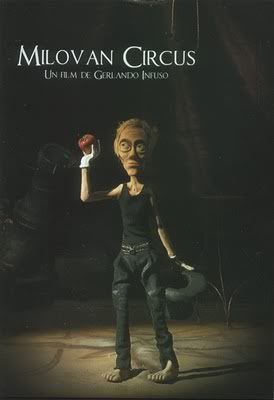
Milovan Circus - Gerlando Infuso (2008)


Sin Diálogos / No Dialogue

Narra la historia del ascenso y caída de la carrera de Iakov, un artista circense. Rememorando aquellos momentos de gloria y de amargura, este mimo nos recuerda que el sombrío panorama del espectáculo está direcatamente vinculado a la soledad.
Elaborado con muñecos en Stop-Motion, este cortometraje fue ganador del Audience Award, Anima Bruxelles 2009.


"(...) Gerlando Infuso, a student in animation at La Cambre, developed a plot centred around a character torn between madness and coldness. One year down the line, a new idea has sprouted – a circus artist faced with rejection and age. With « Milovan Circus », Gerlando Infuso revisits the theme of solitude, the poesy of the grim, and stop-motion animation – elements that had contributed to the success of his previous short. The film certainly impressed the Jury at the 2009 Média 10-10 Festival, since it walked off with the Best Soundtrack as well as the Best Digital Image awards.


A dark night, empty streets, dreams, nightmares. In the cages and wagons of Milovan circus, all is asleep, almost all, or about to sleep, after the wiping off of makeup or the last spitting of fire for the day. The wind, though, is still busy at work – a gust blows a poster away, only to reveal another, an older one, reminiscent of the past glories of the Great Iakov. Bare-chested and barefoot, old and grey, he appears in the cracked mirror of his makeup table. Following the contours of his wrinkles, Iakov relives his memories: his precocious talent for magic tricks, his remakable debut in the circus, his rise to fame, his feelings for a fellow-acrobat, his eviction from the circus subsequent to the hiring of an “unnamable creature”, and his downfall reducing him to a street mime artist.


« Milovan Circus » is an interesting film on many levels. As for the form, Gerlando Infuso, when interviewed about « Margot » after Annecy, explained that he found his style in stop-motion animation, after having tried out several other techniques. « Milovan Circus » proves that he was quite right in pursuing this path – his puppets are just as life-like, grim and poetic as in the previous film. With one small difference – « Margot » was constructed with the help of a voice-over représenting the interior monologue of an obsessive protagoniste, whereas « Milovan Circus » has no sound except its musical score. The flashbacks and the lost empty gaze of the hero tell amply of his interiority, his words and his trials. Faced with this bubble glory and its perverse effects (rejection, oblivion, …), the marionnette Iakov remembers with emotion Calvero, a former star of the Music Hall, played by Charlie Chaplin in « Limelight », another left-over of ephemeral fame." 
Katia Bayer (Format Court)


LINK

https://rapidshare.com/files/1406307669/2008MilovanCircus.G.Infuso.www.nplus2.org.mp4