N+2: CGI
Mostrando entradas con la etiqueta CGI. Mostrar todas las entradas

26 mayo 2012

Aalterate - Christobal de Oliveira (2011)


Flotar / Float
Silente

Una mujer en coma flota en un espacio blanco, inmaculado. De repente, su cuerpo empieza a alterarse, aparecen unas formas orgánicas que van en aumento y llenan la pantalla. Comienza entonces la exploración de este cuerpo en mutación, del cual van a surgir las imágenes de un accidente.


Es la primera película animada del director Cristóbal De Oliveira. El cual nos muestra con impresionantes efectos y formas de belleza sobrenatural la lucha entre la vida y la muerte. La mujer en estado de coma ha decidido suicidarse, pero su cuerpo que ya no le pertenece a ella, es parte de la naturaleza y se defiende con todas sus fuerzas. El cuerpo de una mujer flotando en estado de coma por un área blanca, inmaculada. De repente, el cuerpo comienza a cambiar y formas de plantas crecen fuera de ella, se enredan y, finalmente llenan toda la zona. Un viaje al interior del cuerpo empieza a aparecer, y las imágenes de un accidente de coche. La mujer quiere dejarse ir y sumergirse en el nuevo estado, pero su cuerpo instintivamente se aferra a la vida.


The body of a young woman floating in a coma by a white, pristine area. Suddenly, the body begins to change and plant forms grow out of it, becoming tangled and eventually meet the entire area. A journey into the interior of the body begins to appear, and the images of a car accident. The woman wants to let go and plunge into the world under her, but her body instinctively clings onto life.

"Float" is the first animated film by director Cristobal De Oliveira. The film was produced by Nicolas Schmerkin, the founder of "Autour de Minuit," who was also at the Oscar winner "Logorama" responsible for the production.

Christobal de Oliveira shows with impressive effects and unearthly beautiful forms of the struggle between life and death. The woman in a coma has chosen to commit suicide, but her body that no longer belongs to her, is part of nature and defends himself with all his might.


Rip propio.


LINKS


http://letitbit.net/download/28219.2f03abc7738c2934c0cf158c903c/Fl04t.part1.rar.html
http://letitbit.net/download/41258.452f67605e8fcd7473aadf91f3a8/Fl04t.part2.rar.html

Mirror:
http://vip-file.com/downloadlib/5656099410983677523582-28219.2f03abc7738c2934c0cf158c903c/Fl04t.part1.rar.html
http://vip-file.com/downloadlib/721748186154409121781-41258.452f67605e8fcd7473aadf91f3a8/Fl04t.part2.rar.html

Password: www.nplus2.org

10 mayo 2012

Stich probe - Colectivo alemán (2008)


Muestra aleatoria
Silente | Silent

Sí, es un colectivo alemán, pero no el clásico subanempujenestrujenbajen, sino el compuesto por Gregor Baumert, Luiza Kurc Botelho, Benjamin Burr, Sebastian Elsner, Julia Hofmann, Cordula Landt, Lionel Maccaud, Marcel Morschhauser, Jan Oberhauser, Annette Selcho, Florian Stanger, Johannes Wolf, respiro.


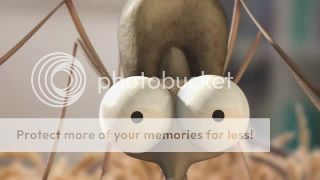
Stichprobe cuenta las (des)venturas de un ácaro y un mosquito, desde una perspectiva sencillísima, con una puesta en escena simple pero no por ello despojada de complejidad. Y no es que se convierta en un tratado de screwball, pero el humor seco de estos muchachitos alemanes oriundos de Stuttgart, que sin dudas homenajean a Thomas Szabo y Hélène Giraud, creadores de Minuscule, es efectivo.


Y digo efectivo en el mejor sentido de la palabra, el CGI, muchas veces rechazado desde N+2 por deshumanizar la animación, es perféctamente utilizado, con sencillez pero a la vez gran claridad conceptual.

Me criticarán, lo sé, pero este es un GRAN corto.


IA: How did you guys exchange ideas, collaborate...?

At first we would just meet for a beer in the sun or at a café near the university to exchange ideas. Later on, during the production phase, we met every day in the lab at university. First we met in one big group, then once we reached the advanced stages we met in smaller groups so each could do their part of the production. Every other day we would meet with the "heads of departments" (if you can have this in such small group production) and talk about results and progress. We were kind of lucky because the motion control stage is not far from the CG and IM lab, only about 3 floors, so the exchange was very fast and direct like: "Hey, we got something here, have a look!"

IA: From the initial design to the final movie were there any major difficulties?

If you do a stop motion project with a scale model environment in the studio and real scenarios on-location, combined with CG elements, your biggest trouble is having the whole workflow in foresight. What does this decision entail and what are the steps. You have to ask yourselves, how much more work will it be in the compositing if we shoot this picture with a reflecting underground? What does this camera movement mean for the movements of the 3D character you will be adding later?

Later on, from the CG point of view, we had some difficulties dealing with the uncertainties in addition to the usual stuff. Some of you reading this article may have worked with Maya so you probably know what I'm talking about: crashes happen when you don't need them, 0 KB files after rendering...

Besides that we had a few "positive" difficulties. There were many long shots where Milbert, one of our main characters, had to walk but we didn't want to animate an entire eight feet by hand so we designed an automatic rig. You could just grab it, move it and all eight feet would move automatically. There were also a few annoying tasks to do. We used the motion control arm for doing camera animations and these animations could be designed in Maya and then converted to Motion Control arm compatible data. In some cases, especially when we did a camera roll, they never fit with the image sequence and we ended up doing the tracking with Boujou for some shots.

IA: What was the part(s) you enjoyed working on the most?

Personally, I like to do animation. This was also a first for me because I'd never done cartoon characters of 8 feet before, there was a lot to play around with. And of course seeing everything coming together...suddenly everything that was done for some elusive reason finally makes sense..

IA: Can you tell us about the tools you used?

For CG we mainly used the standard software. Maya 2008 with Mental Ray for network rendering; Smedge (in an quite old version), Photoshop and Bodypaint for textures and Fusion for compositing. We did shoot on RAW files so we used Lightroom for grading.

IA: How long did it take you to create this short film?

The movie had to be done in less than 12 weeks, which is a semester.

IA: For those who know "Minuscule", your film looks like a great tribute to the series. Were you very inspired by it? What were your other sources of influence?

Yes of course, we were inspired by "Minuscule". Our way of telling the story (if we even have one, our professors weren't really sure :)) is very close to the storytelling of "Minuscule". But as said earlier, the character design is really our own. We also looked at all kinds of cartoons, our characters are quite cartoon like with their big white eyes.

IA: Are you working on any new projects now?

Well, as we are going into a new semester we will start, some of us are going away for internships and others, like me, are doing their bachelor thesis.


LINK

http://www.mediafire.com/?o9130l8kn6wxcyh

08 mayo 2012

Love & Theft - Andreas Hykade (2010)


Amor y Robo
Sin DIálogos / No Dialogue

"Andreas Hykade, profesor de animación en la Escuela de Arte y Diseño de Kassel, es una de las personalidades alemanas más destacadas de la animación de los últimos veinte años. Su último trabajo, "Love and Theft" se presenta este año en Cannes y aunque no se aleja demasiado de su propuesta estética, sí que representa un cambio de intenciones frente a anteriores trabajo[s].


La pieza, basada enteramente en el procedimiento exclusivo de la animación de la metamorfosis gráfica (cuyo pionero absoluto sería Emile Cohl), es en realidad una reflexión curiosa sobre el mundo de la animación, sin argumento ninguno. El viaje rítmico y sobriamente alucinógeno se transforma al final en un plácido pasaje. El cortometraje viene a demostrar la superioridad de la animación frente a otras formas audiovisuales a la hora de "maltratar", manipular y deformar la forma gráfica hasta sus límites y cómo en el fondo un personaje, una imagen no es sino una elección formal."
Sam (Animaholic)


"Andreas Hykade (nacido en 1968 en Baviera) es un director de animación alemán. Desde 1988 a 1990 estudió en la academia de Artes de Stuttgart. Trabajó como dibujante animador en Londres en 1991 y mejoró sus estudios en la Filmakademie Baden-Württemberg hasta 1995. Desde que trabaja como director de animación, distribuye su trabajo en el "Studio Filmbilder" en Stuttgart, así como profesor de animación en la Filmakademie Baden-Württemberg. Desde 2008 Hykade enseña animación en la Harvard University."
 
(...) El estilo de Hykade se fundamenta en la realización de caracteres muy simples que poseen reglas muy básicas de animación. En algunas ocasiones, como ocurre con los videos musicales de Gigi D'Agostino, el personaje se desarrolla en un fondo de colores simples, actuando como el caracter de la La Linea de Osvaldo Cavandoli.
 
 
"(...) An animated film that brings us to the beginnings of the art of animation and moving images, as well as towards our comic book heritage… simple and plain… like a practical example and lesson on design and logos, typography and the power of minimalism… (...)
 
 
Andreas Hykade (1968) studied at the Academy of Fine Arts in Stuttgart. During the 1990s he worked as an animator in London, and studied at the Filmakademie Baden-Württemberg. Since 2000 he was teacher of animation on various institutions: Filmakademie Baden-Württemberg, Royal College of Art London, Kunsthochschule Kassel, Harvard University. He has been working on commercials, TV projects and his films, such as The King is Dead (1990), We lived in Grass (1995), Ring of Fire (2000), The Runt (2006). He had retrospective of his work at Ottawa Festival, Holland Animation Festival, Bradford Animation Festival, and the Museum of Modern Art in New York."
 

LINKS

https://www.rapidshare.com/files/3800538752/2010LoveandTheft.A.Hykade.www.nplus2.org.part1.rar
https://www.rapidshare.com/files/3975105293/2010LoveandTheft.A.Hykade.www.nplus2.org.part2.rar

29 abril 2012

Narodziny Narodu - Kamil Polak (2001)


El nacimiento de una nación / The born of the nation
Sin Diálogos / No Dialogue 

Una obra que, simplemente a partir de puntos blancos sobre un fondo negro, intenta reflejar la progresión del comportamiento humano en sociedad, mejor dicho en masa, una masa de caóticos y ordenados puntos blancos.


Sin duda un interesante cortometraje, ganador del segundo lugar en el Festival Internacional de Wiesbaden, del animador polaco que colaboraría el 2006 en la producción de "Peter & the Wolf" (Suzie Templeton), como supervisor de efectos visuales.


[Kamil Polak] estudió Música Clásica, Ballet y Pintura en la Universidad de Bellas Artes de Varsovia y Dirección de Cine en la Escuela de Cine de Lodz. En la animación ha encontrado la oportunidad de combinar su formación clásica en pintura con su amor por la música y el ritmo.


"Director Kamil Polak studied classical music, ballet and painting at the College of Fine Arts in Warsaw, and excelled in all these disciplines. His love of story-telling brought him to film-making, and in animation he has found the opportunity to combine his classical training in drawing and painting with his love of music and rhythm, and to bring these together in one dramatic narrative. He studied directing at the world-renowned Łódź Film School. His film “Inside” is on the all-time great films reel of the School, and his film “Birth of a Nation” won the 2nd prize at the Wiesbaden International Festival and has been widely sold to international television. He developed THE LOST TOWN OF ŚWITEŹ during his graduation year. Kamil was the Visual Effects Supervisor on “Peter & the Wolf”, a £ 2.5 million stop-frame animation for Channel 4 and for the big screen accompanied by live orchestra."
 (berlin.polnischekultur.de)


LINK

https://rapidshare.com/files/3170738995/2001NarodzinyNarodu.K.Polak.www.nplus2.org.avi

12 abril 2012

Malenkaya nochnaya simfoniya - Dmitry Geller (2003)


МАЛЕНЬКАЯ НОЧНАЯ СИМФОНИЯ / La pequeña Sinfonía nocturna / The little night Symphony
Sin Diálogos / No Dialogue

Un gato negro se queda solo en casa durante la noche. Este corto, en directa alusiva al teatro y basado en la pieza musical de Mozart "Eine Kleine Nachtmusik", explora la percepción del gato en su soledad, cuando los bizarros espectros de la noche salen y danzan entre sí. 


Cortometraje ganador de los premios: Festival «SUZDAL» 2004, Russia; Grand Prix, Festival «KROK» 2004, Ukraina; "Best experimental film" "ANIMAYEVKA" 2004, Bielorusia; Festival "GATO DE LA LUNA" 2007, España.


"(...) Young Dmitry Geller, a Russian author as well, also tells his story without words. A Little Night Symphony (Malenkaya Nochnaya Simphoniya) is indeed based on Mozart's Eine Kleine Nachtmusik, the emotions and the rhythm arising from the music, but nevertheless, Geller has succeeded to make music come alive which in turn is made visible and comes alive through the power of Geller's expressionist drawing, which letting us in on his fantasies as seen through the eyes of a black stray cat."


"[Dmitry Geller] born in Sverdlovsk in 1970. Took part in many painting and drawing shows in Sverdlovsk Saint-Petersburg, Moscow, Copenhagen and Washington. Came to animation industry in 1990. Worked as an animator at A-film Studio in Sverdlovsk. In  1998 started to work as a director. In 1997 finished Higher courses for Animation Screenwriters and Directors. Directed more than 20 animated commercials. At present works at Pchela Studio."


LINK

https://rapidshare.com/files/1353818643/2003Malenkaya.nochnaya.simfoniya-D.Geller.www.nplus2.org.avi

11 marzo 2012

WOFL 2106 - David O'Reilly (2006)


No Dialogue / Sin Diálogo

Un pequeño lobo encuentra muerta a su degollada madre, dándola cómo sacrificio al dios Venado.
Quizás ésta no sea de lo mejor que haya hecho el autor, pero, es una buena forma de introducirse a su cosmos caótico, tétrico y delirante.


Tal vez la obra de este artista no sea del agrado de muchos, sin embargo, como buen amante de la incoherencia, considero a O'Reilly uno de mis favoritos; me parece uno de los mejores exponentes contemporáneos, además de los noventeros D. Hertzfeldt o P. Mulloy, de la inverosímil y retorcida escuela del absurdo minimal.
Un total innovador dentro el campo de la CGI, dándole ese aire fresco que tanto necesitaba esta técnica.


Brilla por su estética, por su equilibrio patrón minimalista, por su agradable incorporación de la sensibilidad en un corto colorido de complejidad. Una narración proscrita a abstraernos en una historia abstracta y técnica.
Una conclusión amplia, amplia en su comprensión.

¿Cual es su fin? ¿Su significado?

Naturaleza¿?
Vida vs Muerte¿?
El otro mundo¿?
La destrucción ecológica¿?
Universos paralelos¿?
Viaje espacio-tiempo¿?
El misticismo¿?
Lo cósmico¿?
Marcianos¿?
Lobos¿?
Apocalipsis¿?
El caos¿?
La libertad¿?
El nacimiento de DAVID O´REILLY¿?
Un conjunto de todo lo anterior¿?
Nada¿?
ChelisCriticalFA (Filmaffinity)


"I freakin love it man! Soooo slick and pretty - you're obviously an experienced animator, but still in this age of all-to-common vector animation, your aesthetic shines through with a subtle and delectable use of color; a very pleasant balance between minimalist patterning and attention to symbolic detail, and characterisation that really pulls the viewer into your own created (albeit fucked up) world. What is perhaps less obvious (though to me equally important to the success of this short) is your ability as a storyteller. Your timing works very well - leaving space for interpretation, whilst still keeping things on a gradual upwards spiral of connections to their surreal and poignant conclusion/anti-resolution. The symbolic components you incorporate display a similar sensitivity to the value of balancing proscriptive narrative with abstract/ambiguous space. Ca march monsieur, ca marche bien. In my experience, these are things that remain near-impossible to learn, and as such you should consider yourself fortunate."
Jason Brooks (Vimeo)


Nota: Por momentos el SPL (o nivel de presión sonora) se eleva abruptamente, por lo que, a personas con sensibilidad, complicaciones auditivas e incluso con auriculares sugiero escuchar el corto a un nivel moderado.

LINKS

https://rapidshare.com/files/1605689476/2006WOFL2106.D.O_Reilly.www.nplus2.org.avi
http://www.4shared.com/rar/UZpGUyx5/2006W2106DORwwwnplus2org.html

27 febrero 2012

Une mission éphémère - Piotr Kamler (1993)


One Ephemeral Mission / Una Misión Efímera
No Dialogue / Sin Diálogos

Una cápsula viene del infinito espacio conteniendo un potencial humanoide cibernetizado dentro, quien se irá formando autónomamente mediante la conjugación y constante movimiento de las formas que yacen dentro la esfera; hasta que, una vez completo el humaniode, comenzará a experimentar el manejo de las formas puras, modificándolas a su antojo mediante un extraño artilugio.


El carácter cíclico y creacionista de esta construcción será, talvez, una evocación al infinito; a ese continuo proceso que algunos llaman "eterno retorno".


Acompañado por la música de Bernard Parmegiani, un pionero en el campo de la experimentación con música electrónica,"Une mission éphémère" fue la última obra elaborada por el artista polaco. Este film combina el uso de Stop-motion y animación por ordenador, logrando así, una cabal simbiosis entre música, imágen y movimiento.


"Piotr Kamler was born in Warsaw in 1936. He is a graduate of the Warsaw Academy of Fine Art. In 1959 he went to Paris to continue his art studies. it was there that he came into contact with Research Department at ORTF (directed by Pierre Schaeffer) and began to collaborate with "concrete" musicians such as Xenakis on experimental shorts (musical abstract films and "fables"). The ORTF Research Department which was later taken over by INA, was a hothouse for talent, enabling diverse artists such as Peter Foldes, Robert Lapoujade, Jacques Espagne, Jacques Rouxel, Andre Martin and Michel Boschet, Jacques Colombat, Jean-Francois Laguionie, Henry Lacam and Kamler to carry out a large number of bold and innovative personal projects.

With astonishing regularity, Kamler came up with no less than 8 unusual short films between 1962 and 1973. The films themselves were incorrectly described as science fiction-in fact they were much closer to the universe of Borges than to Space Opera. Kamler, who created strange, improbable but plausible world, began to explore a whole range of different visual techniques. Le Trou (1968), Araignelephant (1968), Delicieuse Catastrophe (1971), Coeur de secours (1973) all won awards at major film festivals (Cracow, New York, Mamaiea , Melbourne...). After Le Pas (Grand prix at Annecy 1975) Kamler went underground for a while until he resurfaced with the full-length feature Chronopolis (1982).

Kamler's animated cinema suggests a singular variety of science fiction; it was he who provided the original idea for the Shadoks TV series. Completely unalike to more conventionally linear and text-based narratives, Kamler's films instead explore a series of dynamic visual motifs. Typically, the conclusion of these films is less suggestive of resolution, than it is of recurring episode. What is most striking in all his films is the variety of visual invention that Kamler brings to each work - he is as assured working with clay (as in his feature, Chronopolis) as he is with ink and paper, or even animating digitally on computer (in the most recent work in this program, Une mission ephemere). These visual flourishes embellish some of the most amazing animated films ever made - an achievement which won his Le Pas the Grand Prix of the 1975 Annecy Animation Festival.


LINK 
 
https://rapidshare.com/files/2052142328/1993UneMissionEphemere.KamlerPiotr.www.nplus2.org.avi

24 febrero 2012

Walking on by - Theodore Ushev (2003)


Caminando por ahí
No Dialogue / Sin Diálogos

Este corto relata la vida cíclica de un individuo desde la perspectiva misma de su andar, mostrando logros y trivialidades a las que hay que enfrentarse cuando uno va caminando por ahí. Animado mediante Flash, en los primeros intentos de dicha técnica, esta muestra denota una estética visualmente simple pero a la vez concreta y bien definida, sello de la obra de este autor.


Nacido en Bulgaria, Theodor es egresado de Bellas Artes de la Universidad de Sofía.
Emigró a Canadá en 1999, donde rápidamente adquirió una buena reputación como animador con cortometrajes como The Man Who Waited y Tzartitza, que le valieron numerosos premios. Como director de animación de la película en 3D Facing Champlain, Ushev sobresalió por su afilado talento y su interés en desarrollar nuevas plataformas de entrega de contenidos, como se evidencia en su sitio web y en su micro-película Sou, creada para visualizarse en teléfonos celulares.


Theorore Ushev is one of my favourite animators and a helpful one as well. I use his work to demonstrate the possibilities of Flash animation with my students. He's also a superb artist which helps. He has two independent outlets for his work, ushev.com/ and mortadellatv.com. I'm featuring two of his animations but all his work is better than excellent. Walking On By is just that: a guy takes a stroll through all the stones and arrows that life can throw at him. He's as bouncy at the end as he is at the beginning. It was produced in 2003 and has been used with all my classes to explain the walk cycle and much beyond. Theodore is very witty and his simply drawn character and basic idea is a triumph of its sort... Theodore was born in Bulgaria but moved to Canada in 1999. Increasingly his work is not available on-line. He is however becoming a mainstay of the North American and European festival circuit. Last year his Tzaritza opened the Carrousel International du Film de Rimouski. ("Little Lili finds a tzaritza, a magic shell that will grant her a wish. She decides to use this magical gift to bring her grandmother, who lives near the Black Sea, to Montreal." NFC) His latest movie, Tower Bawher, is due to be screened later this month at the Ottawa International Animation Festival 2007. It's described by the National Film Board of Canada as a "wild ride through the pages of a chapter in modern art" which sounds just about right for Theodore.
Ian Lumsden (Animation Blog)


Theodore Ushev is an animator, graphic designer, illustrator and multimedia artist, from Montreal, Quebec, Canada.
He was born in Bulgaria and graduated stage decoration, animation, and make-up at Plovdiv's School of Scenic Arts. He obtained a Master degree in Graphic Design from the National Academy of Arts in Sofia. He first made a name as a poster and graphic designer, before moving to Montreal in 1999. There he quickly gained a reputation as an animation filmmaker with for the National Film Board of Canada, with films such as Vertical, The Man Who Waited, Tower Bawher, Tzartitza, Sou and Drux Flux, winner of the Canadian Film Institute Award for Best Canadian Animation at the Ottawa International Animation Festival. In 2010, he completed a short animated documentary about Arthur Lipsett, entitled Lipsett Diaries. In March 2011, Lipsett Diaries received the Genie Award for Best Animated Short at the 31st Genie Awards.


He created live show multimedia and promo animations for the British band Public Symphony and David Gilmour’s “In an Island” album and live tour, and the illustrations for Chris Robinson' book "Ballad of a Thin Man: In Search of Ryan Larkin" (2008).


 LINK

https://rapidshare.com/files/2481337504/2003Walkingonby.TheodoreUshev_www.nplus2.org_.mp4